
Free written scope consultation - allowances, timeline, and change-order rules on paper before a single trade is scheduled
Windows & doors
 Before
 After
After Before
 After
After Before
 After
AfterSakrete Home Additions & ADU: The Santa Clara Owner’s Guide
We stock and install Sakrete-compatible concrete and masonry materials for home additions and ADU foundations in Santa Clara, with typical installed project costs running $45,000-$130,000 for additions and $90,000-$220,000 for full ADU construction. Most Santa Clara homeowners who call us about Sakrete products discover the issue during a foundation inspection, either because their contractor flagged deteriorating slab edges or because a city inspector noted spalling concrete during the ADU permit process. In the older neighborhoods near Washington Street and the Alviso district, we regularly see Sakrete High-Strength Concrete Mix that was poured without proper curing in Santa Clara’s dry summer heat, leading to surface scaling that shows up three to five years later.
Which Sakrete Models This Applies To
The Sakrete products we handle most often for Santa Clara additions and ADUs fall into three categories: High-Strength Concrete Mix (the gray 60- or 80-pound bags rated at 4,000 psi), Fast Setting Concrete Mix (the red-labeled blend that sets in 20-40 minutes), and Mortar Mix Type S (for CMU block walls and brick veneer ties). To identify what was originally used, check the permit drawings if they specify a mix design, or look for residual bag fragments in the garage or storage shed. Many Santa Clara ADU builders from 2018-2022 used the Fast Setting blend for footing pours to beat weather windows, but that mix demands precise water control. Too much water drops the effective strength by 15-20 percent, which is why we see corner cracking in ADU slabs poured during rushed fall schedules.
We are an independent contractor and not affiliated with Sakrete. For OEM-equivalent performance, we source through our verified supplier network, including matching specs to brands like KraftMaid for interior finish coordination and Cambria or Silestone for slab-adjacent wet-area thresholds where concrete moisture migration matters.
Signs Your Sakrete Home Additions & ADU Is Failing
- Surface spalling and pop-outs. Small chunks of aggregate breaking loose across the slab surface, usually caused by freeze-thaw cycling combined with Santa Clara’s occasional hard-water mineral deposits. The surface layer loses bond when curing was rushed in direct summer sun.
- Corner and edge cracking. Hairline fractures radiating from slab corners or where the addition meets the existing foundation. This happens when the Fast Setting mix was over-watered or when control joints were cut too shallow, typically under 1 inch on a 4-inch slab.
- Efflorescence on block walls. White powdery deposits on CMU surfaces, indicating moisture is moving through the mortar joints. In Santa Clara’s clay-heavy soils near the Guadalupe River corridor, this often means the Type S mortar bed lacked a proper dampproofing membrane below grade.
- Slab settlement with door frame gaps. The ADU door starts sticking or a visible gap opens between slab and sill plate. This points to inadequate compaction before the Sakrete pour, or organic soil that wasn’t removed, a common shortcut in backyard ADU conversions.
- Rebar corrosion staining. Rust-colored streaks bleeding through concrete surfaces, meaning the rebar cover was less than the 1.5-inch minimum for interior or 2-inch for exterior exposure. Santa Clara’s winter ground moisture accelerates this once the carbonation front reaches the steel.
 Before
 After
AfterReplacement Cost & What’s Included
| Scope | Price Range |
|---|---|
| Partial slab repair (spalling, up to 200 sq ft) | $3,500-$8,500 |
| Full ADU foundation replacement | $12,000-$28,000 |
| CMU block wall rebuild (per linear foot) | $85-$165 |
| Complete home addition, foundation through finish | $45,000-$130,000 |
| Detached ADU, ground-up construction | $90,000-$220,000 |
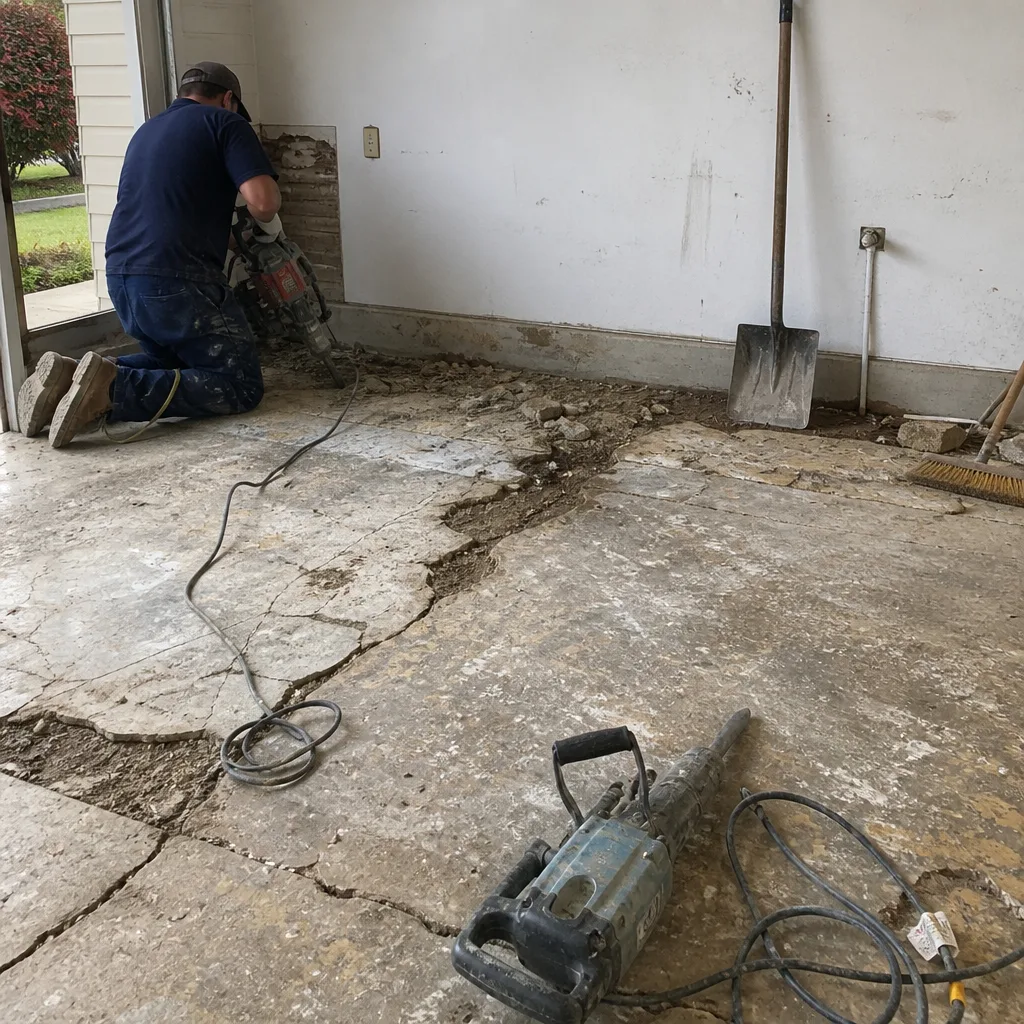
The range depends on three factors: how much concrete must come out (hydraulic demo adds $800-$1,500 per day), whether we hit unexpected rebar corrosion that requires epoxy-coated replacement steel, and if the city requires a soils engineer report for the permit amendment. Under Clause 1 of the Haven Standard, you get a written flat price before we start, with line-item breakdowns for concrete, labor, haul-away, and permit fees. Every project carries our 365-Day Done Right Promise, and we include a documented photo record of the demo and pour as standard deliverables.
DIY or Call Us?
There’s a clear line here. An owner can safely check: measure crack widths with a ruler (hairline under 1/16 inch is typically shrinkage, not structural), photograph efflorescence patterns for documentation, and verify the original permit specifies the Sakrete mix design that was actually used.
Where DIY goes wrong is everything past diagnosis. Cutting out a failed slab section without shoring the adjacent structure risks wall settlement. Pouring new concrete against old without a bond breaker or proper doweling creates a cold joint that will crack within two Santa Clara wet seasons. And rebar placement at the correct depth, with proper chairs and tie wire, is not intuitive work. We’ve rebuilt three owner-attempted ADU slabs in the past two years, each one costing roughly double what the original proper pour would have run. If you’re seeing the symptoms above, call (669) 259-1843 and we’ll schedule a free estimate with a written scope.
FAQs
A properly mixed, placed, and cured Sakrete slab should last 50-plus years. In Santa Clara’s climate, the main threat is not freeze damage but inadequate curing in 90-degree September heat and moisture migration from clay soils. We see premature failure at year 3-5 when the pour was rushed or the water ratio was off. Call (669) 259-1843 for an exact quote on your specific condition - estimates are free.
Spalling under 1/4 inch deep and corner cracks under 1/8 inch width can often be repaired with polymer-modified overlay or epoxy injection. Full replacement becomes necessary when rebar is actively corroding, when settlement exceeds 1 inch, or when the original pour was fundamentally out of spec. We assess this during our site visit and document it in the photo record. Call (669) 259-1843 to schedule.
Demo and repour of an ADU slab runs 7-10 working days, plus cure time before framing loads apply. Permit amendments in Santa Clara typically add 10-14 business days if a soils report is triggered. We build this into the written schedule before work starts, under Clause 1. Call (669) 259-1843 for a timeline specific to your project.
We maintain inventory of Sakrete-equivalent high-strength and fast-setting mixes through our Santa Clara supplier, with standard rebar sizes (#4 and #5) and epoxy-coated options for corrosive soil conditions. Specialty items like low-shrinkage admixtures for large pours are ordered to spec once the written scope is signed. Call (669) 259-1843 to confirm availability for your project.
Grant Rowan and our crew have worked across Santa Clara for several years now, from residential additions near the Caltrain corridor to backyard ADUs in the older neighborhoods off El Camino Real. We keep a running list of every tool that has ever failed us mid-project, mostly as a reminder to buy better next time. That same discipline applies to how we specify concrete: measure twice, document once, and never assume the last contractor left things square.
Ready to get a written price before anyone picks up a tool? Call (669) 259-1843 to schedule your free estimate. We’ll review your existing conditions, confirm the Sakrete spec or recommend the equivalent that matches your permit, and deliver a flat written price with a line-item scope. We also offer a Free Second Opinion on any written estimate you’ve already received - bring it in and we’ll review it line by line at no charge.
Written by Grant Rowan, Owner, Rowan Construction Group Santa Clara at Rowan Construction Group Santa Clara, serving Santa Clara and nearby areas.